Tuesday, 20 September 2016

ROLE OF DIET IN HAIR GROWTH

                    ROLE OF DIET IN HAIR GROWTH


A Good Diet can help in improving the hair growth naturally 


Healthy  locks  are  the  sign of  confidence, describing your individual physical characteristics. Not  for  the cosmetic  reasons , hair  is  also  a  great  marker  of  overall  health. A  healthy diet and  smart  lifestyle  changes , can  have  your  hair  and  health  look  luscious.

Hair  starts  its  lifespan  in  small,  sack- like  structures  in  the  skin  known as  follicles. Each  follicle  produces  a  single  hair  shaft  composed  of  a  hard  protein  called keratin. Each hair has  distinct  growth  cycle- active  growth, maturation and rest. If  you are  facing unusual hair problems with dryness, splitting or breakage or you want to have beautiful locks , nutrition will definitely help you out. What you can do, is to start a hair -healthy diet today. Good nutrition assures the  best possible environment  for building strong, lustrous hair. 


Some of the essential nutrients:-

1. B VITAMINS: Folate, B6, B12

Foods rich in folates , B6, B12 -  Chickpeas, wild salmon,  potatoes,  oats,  bananas, lentils, broccoli, eggs, peanut butter, watermelon, spinach,  green peas, papaya,  wheat germ, soybeans, black eyed peas,  avocados, whole grain bread.

2.BIOTIN

Foods rich in biotin- Eggs, peanuts, almonds, almond butter, wheat bran, walnuts cauliflower, raspberries.

3. IRON- RICH DIET

Foods for iron -rich diet - Clams, oysters, egg yolks,  tofu, starchy beans, lentils, black eyed peas, seaweed,  spinach, mustard greens, brussels sprouts. 

4. VITAMIN C- Guava, papaya, lemons, cabbage, cauliflower, turnip greens, tomatoes, kidney beans, kiwi, grapefruit juice, pineapple, oranges, strawberries, raspberries, blackberries.

5. BETA CAROTENE

Foods rich in beta carotene- Sweet potatoes, carrots, butternut squash , pumpkin, mustard greens, red peppers, apricots, cabbage, watermelon,  cherries, mango, guava.

6.ZINC

Foods rich in zinc- Oysters, crab, wheat germ, pumpkin seeds, lentils, pine nuts, cashews, peanuts, peanut butter, sunflower seeds, butter.


Monday, 19 September 2016

Platelet Rich Plasma: Hair Loss Treatment

Image result for prp hair treatment 
Platelet Rich Plasma: Hair Loss Treatment

PRP therapy for hair loss is a treatment that involves withdrawing a patient's own blood, processing it so that only the enriched cells (platelet-rich plasma) remain, and injecting it into scalp.
It is being used on the scalp as it can apparently stimulate dormant hair follicles and encourages starting growing again. It is a potential form of treatment for men and women who suffer with hair loss either through genetic predisposition, hormonal issues resulting in the stimulation of natural hair growth.
New hair growth can be seen as early as 2 months, but is typically evident between 5-8 months and will continue to improve up to a year after treatment.

At Cosmo world,PRP therapy is a versatile tool in the treatment of hair loss for a number of causes including:

1. Male Pattern Hair Loss are especially in the early stages of balding,or anytime there is a lot of miniaturized hair on the scalp. 3-6 sittings are recommended at an interval of 1 month each.
2. Female Pattern Hair Loss are at all stages of hair loss
3. Hypotrichosis (fine/reduced hairs) of the eyebrows or beard
4. Alopecia Areata, Alopecia Totalis
5. After Hair Transplant
6. Due to metabolic reasons and iron deficiency anemia.


Monday, 12 September 2016

Sulphates on Hair: Effects and Tip


Image may contain: 1 person , close-up and text
Sulphates on Hair: Effects and Tip


What are Sulpahtes ?
One of the most common ingredients used in most shampoos are sulfates. Sulfates are detergents used to make the shampoo lather. They're are inexpensive to use in shampoos, which explains why more than 90% of shampoos contain them.

Effects of Sulfates on Your Hair and Scalp
There are many negative effects that sulfates can cause to your hair shaft, hair follicles, and your scalp. Some of these include:
Dry hair and scalp. Sulfates dissolve all of the natural oils on your scalp, thus leaving your hair and scalp dryer than normal.
Scalp irritations. Sulfates have the potential to worsen dandruff and eczema. In turn they also leave your scalp feeling tight and itchy.
Fading hair colour. If you colour your hair, the aggressive cleansing that sulfates gives you will strip your hair of that colour, leaving you with dull, faded locks.
Hair loss. Sulfates corrode and damage your hair follicles, which leads to hair loss. This is especially true if you don't properly rinse shampoo out of your hair.

Switching to a Sulfate-Free Shampoo

When switching from your regular shampoo to a sulfate-free shampoo, there may be a few minor things that you will need to get used to. Even if you struggle with these changes, you should always keep in mind that switching to a sulfate-free shampoo is the beginning to having a healthier scalp and healthier hair. The struggle will be worth it.
1. No lather. The first thing that you are going to notice about sulfate-free shampoos is that they do not lather. This is a problem for many people because they do not feel that their hair is being properly cleansed. However, you must remember that the only reason that other shampoos lather so much is due to the sulfates that are contained in them. If you are going to avoid sulfates, you must accept the fact that your sulfate-free shampoo is not going to lather like your old shampoo did.
Some tips for getting the most lather out of your sulfate-free shampoo:
Make sure your hair is thoroughly saturated with water before applying the shampoo to your hair.
Wash your hair twice! The first shampoo will remove the dirt and oil from your hair, making it easier for your shampoo to lather during the second wash. Washing your hair twice with sulfate-free shampoo is still less damaging than washing your hair once with sulfates.
2. Oily Hair. You may also notice that after switching over to your new, sulfate-free shampoo that your hair tends to feel oily a lot faster than it used to. Now that you are not stripping your hair of all of its natural oils, some people may find that their hair feels like its becoming oily quickly. Although nothing can moisturize your hair as well as your hair's natural oils, this can be a problem for some people, especially if they don't like to wash their hair as often as others do.
All in all, protecting your hair from the potential damage that sulfates can cause is well worth adapting to the changes that come along with using a sulfate-free shampoo!

Friday, 9 September 2016

DRUGS AND MEDICATIONS INDUCED HAIRLOSS

DRUGS AND MEDICATIONS INDUCED HAIRLOSS   


Alopecia  from  drugs  is  usually  considered   as  a  reversible  diffuse  non  scarring  hairloss that  occurs  within  days  to  weeks  of  starting  a  new  medication  or  changing  the  dose. In other  terms  we  can  say  that  medication  is  designed  to treat various  health  conditions but sometimes  they  can  have  unwanted  effects  contributing  to  changes  in  hair color or texture  or  even hair loss. Medicines  basically  cause  hair  loss by  interfering  with  the  normal  cycle  of  hair  growth  which  are  Anagen phase,  Catagen  and  Telogen  phase.

The  development  of  hairloss  and  the  severity  depends  both  on  the  drug  and  on individual   predisposition.  The  severity  of  medication - induced  hairloss  depends  on  the  type  of  medication  and  dosage  as  well  as  your  sensitivity  to  that  medicine.  Medications  can  lead  to  2  types  of  hairloss:-

  • TELOGEN  EFFLUVIUM-  is  the  most  common  form  of  medication  induced  hairloss   which  usually  appears  within  2 to 4  months  after  taking  the  medication. This  condition  cause  the  hair  follicles  to  go  into  their  resting  phase  and  fall  out  too  early. 
  • ANAGEN  EFFLUVIUM- is  the  hairloss  that  occurs  during  the  anagen  phase  of the hair cycle,  when  the  hairs  are  actively  growing,  it  prevents  the  matrix  cells  which  produce  new  hairs,  from  dividing  normally . This  type  occurs  usually  within  a  few  days  to  weeks  after  taking  the  medication. It  is  commonly  seen  in  people  taking   chemotherapy  medications  and  is  often  severe.
Medications  causing  hairloss  can  be  categorised  under:-

  1. Acne  Medications
  2. Antibiotic  and  Antifungal
  3. Chemotherapy Medications
  4. Cholesterol  lowering  medications
  5. Antihypertensives
  6. Anticonvulsants
  7. Steroid's
  8. Mood Stablizer's
  9. Thyroid Medication.

How can be Treated?

It is important to review any medications you take and discuss their potential side effects with your doctor. when hair loss occurs from a medication you are taking,there is a good chance that the hair will grow back on its own after you stop taking it. If stopping the medication does not help you grow back your hair then you need to be treated with a medication that stops hair loss and can stimulate new hair growth.


Wednesday, 31 August 2016

Damaged Hair: How to Prevent It. !!


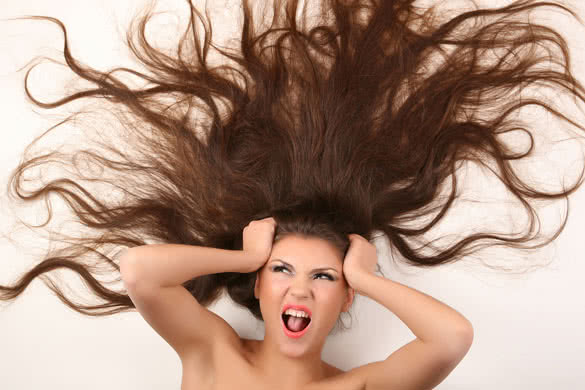
beautiful young woman screaming
Have a look at the following seven deadly sins of hair care – and avoid them at all costs!
1. Rubbing wet hair dry
Your hair is most fragile when it’s wet, so by rubbing it dry (which most of us tend to do) you’re causing more damage to your hair than necessary. Instead, why not dry squeezing the remaining water out and dabbing it with a dry towel. Once it’s dry you can then start brushing it out to avoid irreparable damage to your hair strands.
2. Applying heat often
Ladies love using our extremely expensive flat irons and volumizing hair dryers, and understandably so. However, the heat from a flat iron can cause damage to your hair even at lower temperatures–especially if your hair is still damp, have been bleached, dyed, or even permed. You may not notice it straight away, but your hair may look a little bit lifeless and dull after a while – perhaps even show some signs of singeing.
3. Washing everyday
As with your skin, your hair needs natural oils. Thus, by washing it daily, you’re stripping your hair of those essential oils used to keep your hair smooth and shiny. This then creates a typical dryness, perhaps even hair fall that you’d want to avoid at all costs. 
4. Never cleaning your brushes
You’d be surprised at the amount of critters and microscopic germs you’ll find when looking at your brushes from an extreme close-up angle. However, most of us tend to forget about cleaning those while we’re busy making sure we shampoo our heads regularly. Make sure you wash between the bristles.
5. Pulling hair too tight
You may be all too familiar with the dreaded receding hairline if you’ve been pulling your hair tight into a ponytail. Don’t panic! It takes a while for the effects to show, but it’s the easiest way to cause breakage and hair loss. So whatever you do, don’t forget to release some of that tension on top of your head. Not only will you experience fewer headaches caused by tightness, but your hair will last longer as the years pass.
6. Adding too many chemicals
We’ve all been there – changing our minds when it comes to wanting to be a brunette or a blonde, or even bleaching. These types of chemicals change the inner structure of the hair – making your hair more susceptible to damage. 
7. Brushing your hair too often
.It’s a good idea to brush your hair once or twice a day, but that’s where it should stop. Over-brushing will cause your hair to fall out quicker, due to the pulling action, and leave you with added tangles if you’re using a cheap brush. 


Friday, 26 August 2016

FUT OR FUE ... which is better ??????

Image result for fut vs fue

FUT or FUE .....which is better ?? 
It ls the one of the common question which comes in mind of every individual person who is looking for Hair Transplant. Another is what is Hair Transplant & how does it actually works ?
Lets discuss these common queries ...
Hair Transplant  is a surgical treatment to regrow hair on the bald area of the scalp by grafting donor hair. It involves taking hair follicles tissues from scalp area that is unaffected by hair loss pattern and is resistant to hormonal changes that causes hair loss. Those donor hair follicles tissues are then grafted on the bald scalp area to re-start the hair growth cycle. There are two methods used by surgeons for removing hair grafts — Follicular Unit Extraction (FUE) and Follicular Unit Transplantation (FUT).
FUT is suitable for:
  • Patients who have large bald areas and prefer covering it in single sitting transplant surgery.
  • Patients who aren’t bothered about cuts, stitches and are mentally prepared for long recovery process that may take several months.
FUE is suitable for:

  • People who want faster recovery.
  • People who are scared of cuts and stitches on the scalp, as this method doesn’t need any cutting or stitches.
FUT is a traditional and older technique used for hair transplant in which a thin strip of scalp cut from the area where hair loss is not in effect and has healthy hair growth. Then this cut strip of scalp is dissected into graft.
 On the other side FUE is a new technique in which a specialized hair follicle extraction machine is used to harvest follicular units/grafts from hair-bearing scalp area. This procedure is lot more precise and less painful. In fact patients doesn’t even feel any pain with local anesthetic effect.
Besides the technique used in FUT and FUE for taking donor hair tissues, rest of the hair grafting procedure is pretty much similar. Both the techniques requires cuts on the bald scalp areas by using extremely fine blades and needles. After these cuts and slits are made, donor hair grafts are inserted in the scalp area where hair loss has occurred.
Benefits of FUT Technique:
FUT method is generally suggested by the surgeons to patients who have large bald areas, because with FUT technique large areas can be covered a lot faster and require fewer sittings.
Benefits of FUE Technique:
Given the fact Follicular Unit Extraction method does not require surgery for taking strip of donor hair-bearing scalp, there is no need for making cuts and stitches in this technique, therefore it is a less painful.
No stitches and cuts means there won’t be linear scars, and this method also take less time time, which means the patients can go home next day and may even return to work.
Both FUT and FUE techniques require surgery for hair transplant, therefore it suggested to thoroughly consult with the surgeon about the advantages and disadvantages of both the methods before you pick one. Generally a hair transplant surgery takes several hours for the entire process of taking donor hair and grafting them on bald area, therefore it is important to schedule your work for the day accordingly and be prepared mentally for long procedure of surgery.
After Surgery Care
You must listen and understand the post hair transplant surgery instructions given by the surgeons to take care of hair grafts otherwise you have to face consequences. After surgery, for few days there will be some swelling on scalp and face, which is normal and fades away in few days. Your surgeon would describe your antibiotics, anti-inflammation medicines and painkillers for few days and he may also ask you to use Minoxidil or Finasteride as well.
Newly implanted hair grafts are applied with a liquid for nourishment for few days repeatedly. Grafted hair are washed with mild diluted shampoo with extreme care so that it doesn’t affect or disturb the grafts. These grafted hair naturally fall off in couple of weeks, and after that new hair growth cycle is started that can be seen on the scalp in 3-6 months. Particularly in FUT technique post surgery care for the scars is highly imperative to prevent infection. In this method sutures are removed in a week’s time.
People often do not know the fundamental difference difference between FUE & FUT & there is discussion among many which is the most effective method to get the best Hair Transplant results. But the Reality is both are effective & when combined together in the hands of an experienced Hair Transplant specialist it can give the most effective one time Hair Transplant Solution.
+Cosmoworld clinics offers best FUE hair transplant surgery in india at affordable price by internationally certified doctors. Contact / Booking an appointment - 9643643731 / 9463636652


Sunday, 21 August 2016

INTERESTING FACTS ABOUT HUMAN HAIR

INTERESTING FACTS ABOUT HUMAN HAIR


      A QUICK REVIEW

  • It  is  normal  to  loose 40-100 hairs a day.
  • Only 90% of your hair follicles are active at a time and the other 10% are in a rest phase.
  • On average, the scalp contains 100,000  strands of hair i.e 1000 hairs per square inch.
  • One strand of hair can carry a weight of 100 grams.
  • A whole head of hair could support up to two tons.
  • Hair is the second fastest growing tissue in human body with the first position being taken by bone marrow. 
  • There are on an average , 100,000 to 1,50,000 strands of hair on a human head.
  • Hair elasticity is greater for Asians than any other races in this entire world. Interestingly Asian hair grows faster compared to other races.
  • Our body has insulating fat layers. The only place where the layer is absent is our head and thus our hair works as insulators.
  • Hair contains information on what has been through your blood stream,including minerals and drugs.
  • Hair is one of the most common types of forensic evidence. 
FORGET NOT THAT THE EARTH DELIGHTS TO FEEL YOUR BARE FEET AND THE WINDS LONG TO PLAY WITH YOUR HAIR.